
Diatomaceous Earth: Benefits, Uses, Science & Safety
Discover the fascinating story of diatomaceous earth,
a naturally occurring material formed from microscopic
aquatic life. Explore its unique properties, everyday
applications, and what scientific research has
discovered about this remarkable substance.
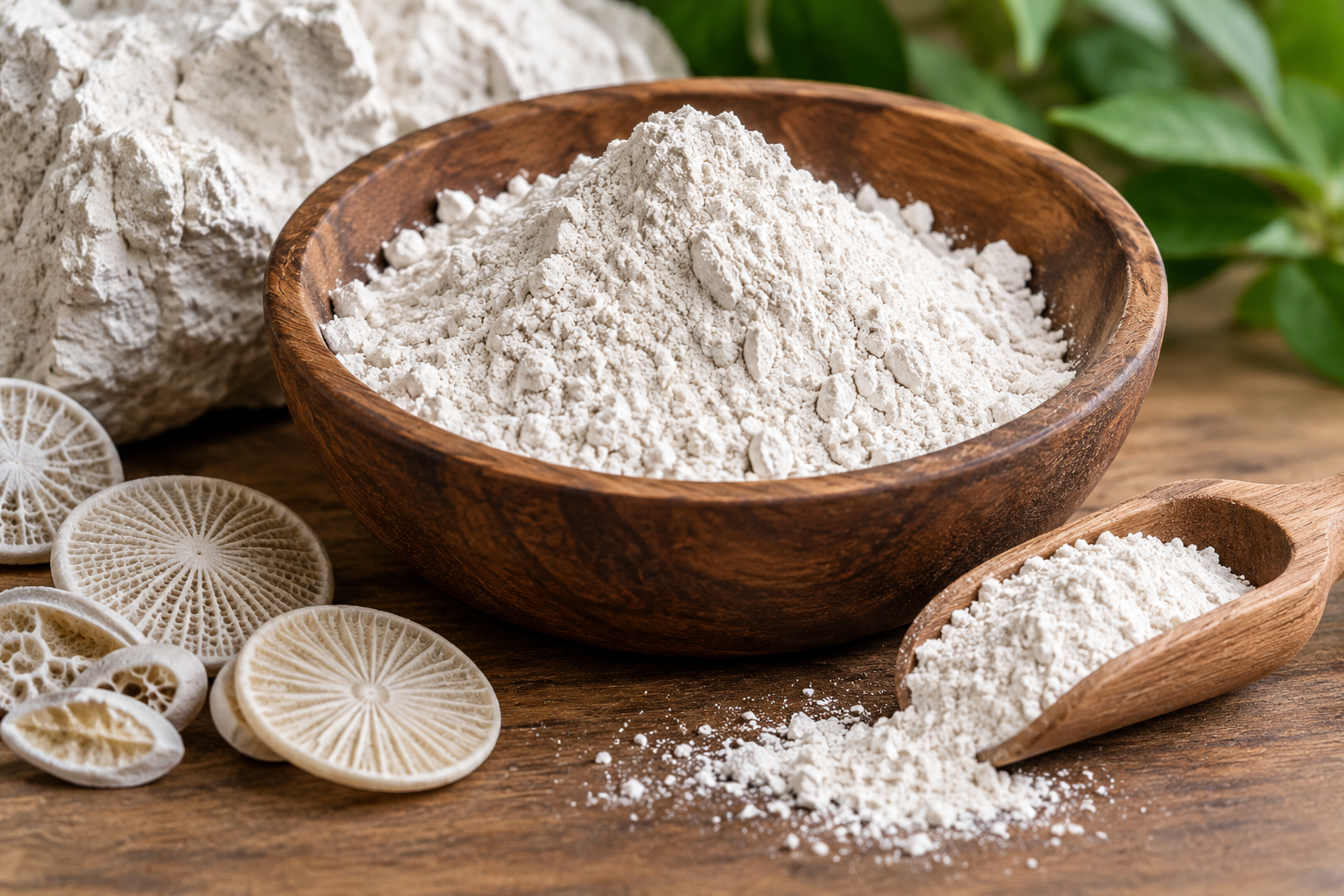
Table of Contents
Select a topic to explore
01
What Is Diatomaceous Earth?
↗
04
Silica and Natural Minerals
↗
05
Food-Grade and Other Types
↗
06
Traditional and Modern Uses
↗
07
Diatomaceous Earth and Human Health
↗
08
Published Scientific Research
↗
09
Important Safety Considerations
↗
10
Frequently Asked Questions
↗
What Is Diatomaceous Earth?
Diatomaceous earth, often called DE, is a naturally occurring, soft sedimentary material made from the fossilized remains of tiny aquatic organisms known as diatoms.
Diatoms are microscopic algae that have inhabited the Earth’s waters for millions of years. They live in oceans, lakes, rivers, and other aquatic environments.
Each diatom forms a delicate outer structure made primarily from silica, a naturally occurring compound containing silicon and oxygen.
Over enormous periods of time, countless diatoms settled onto the bottoms of ancient bodies of water. Their silica-rich remains gradually accumulated into deposits that can now be mined and processed into diatomaceous earth.
To the naked eye, DE resembles a fine, pale powder. Under a microscope, however, its particles reveal an extraordinary collection of intricate shapes, tiny openings, and delicate fossil structures.
What Makes Diatomaceous Earth So Unusual?
Ancient Natural Origins
DE is formed from the accumulated remains of microscopic organisms that lived in ancient aquatic environments.
Rich in Silica
Its primary component is silica, a compound found throughout nature in rocks, sand, soil, and many living organisms.
Microscopic Structure
Diatom fossils have intricate, porous structures. Their shapes help explain DE’s usefulness in filtration and other applications.
Lightweight and Porous
The tiny spaces within DE particles give the material a relatively low density and useful absorbing properties.
How Is Diatomaceous Earth Formed?
The formation of DE begins with living diatoms. These microscopic organisms absorb dissolved silica from water and use it to construct their protective outer shells.
When the organisms die, their shells can sink to the bottom of the water. Over thousands or millions of years, enormous quantities may collect in thick layers.
Geological changes can eventually expose these deposits, allowing the material to be mined. The resulting DE may be dried, crushed, screened, or otherwise processed according to its intended application.
Because deposits originate in different environments, their mineral composition, purity, particle size, and physical properties can vary.
Understanding Silica and Natural Minerals
Silica is the main component of diatomaceous earth. Chemically, it is known as silicon dioxide.
Silicon is a naturally occurring element present in the environment and in small quantities within the human body. Researchers continue to investigate its biological roles.
Depending on the source, DE may also contain varying amounts of other minerals, including calcium, magnesium, iron, and aluminum compounds.
However, the presence of a mineral in a natural substance does not automatically mean that the body can absorb or use it efficiently.
Silica is not the same thing as a clinically proven mineral supplement. Most ingested diatomaceous earth passes through the digestive system without being absorbed.
Food-Grade and Other Types of Diatomaceous Earth
Not all diatomaceous earth is produced for the same purpose. Understanding the differences is important.
Food-Grade DE
Food-grade DE is processed to meet requirements for particular food or feed-related applications.
It may be used in limited amounts as an anti-caking agent or as part of certain food-processing operations.
Food-grade classification does not establish that taking DE as a dietary supplement provides health benefits.
Filter-Grade and Industrial DE
Some forms of DE are processed for industrial filtration, including swimming pool filters.
High-temperature processing can increase the proportion of crystalline silica in certain products.
Industrial and pool-filter grades must never be consumed.
Traditional and Modern Uses of Diatomaceous Earth
The unusual structure of DE has made it useful in a surprising variety of commercial, agricultural, and household applications.
Filtration
DE can help remove suspended particles from liquids. Certain processed grades are used in beverage production, industrial filtration, and water-treatment systems.
Food Processing
Suitable food-grade forms may be used as processing aids or anti-caking agents under applicable regulations.
Insect Control
Certain registered DE products help control insects by damaging or absorbing protective materials on their outer surfaces, causing moisture loss.
Absorbent Materials
Its porous structure makes DE useful in some absorbent products, industrial materials, and specialized applications.
Diatomaceous Earth and Human Health
Interest in diatomaceous earth has expanded beyond its established industrial and agricultural applications.
Some people use food-grade DE as a dietary supplement and associate it with digestive cleansing, mineral support, cholesterol management, skin appearance, and general wellness.
These reported uses should be distinguished from benefits demonstrated through reliable clinical research.
Digestion and Cleansing
DE is sometimes promoted as a natural intestinal cleanser. However, convincing human clinical evidence has not established that consuming DE removes intestinal parasites, treats digestive disorders, or detoxifies the colon.
Cholesterol and Circulation
One small preliminary human study investigated DE and cholesterol levels. Although the results were interesting, larger controlled trials are needed before drawing conclusions about cardiovascular benefits.
Skin, Hair, and Bone Health
Silicon compounds are of scientific interest in studies of connective tissue and bone biology.
However, this does not establish that consuming diatomaceous earth improves hair growth, reverses skin aging, strengthens bones, or prevents osteoporosis.
Diatomaceous earth has well-documented physical and industrial properties, but many of its advertised internal health benefits remain unproven.
What Have Scientists Discovered About Diatomaceous Earth?
Scientific studies help us understand both the possibilities and limitations of this natural material.
The following research summaries are written in everyday language, with links to the original publications.
Can Diatomaceous Earth Influence Cholesterol Levels?
In 1998, Austrian researchers investigated DE in 19 adults who had moderately elevated cholesterol levels.
Participants took DE for eight weeks while researchers monitored their blood cholesterol and other measurements.
Average total cholesterol fell during the study, reaching approximately 13.2 percent below its starting level at week six.
What does this mean? The findings were interesting, but the study was small and lacked a placebo comparison group. It cannot establish that DE reliably lowers cholesterol.
Read the published study
Why Can DE Help Control Certain Insects?
A scientific review published in 2021 examined DE as a material for controlling various insect and arthropod pests.
Researchers described how DE particles can interfere with the protective outer covering of certain insects.
As insects lose moisture, they may become dehydrated. Effectiveness depends on the product, pest species, environment, and application.
What does this mean? This research supports DE’s usefulness in certain pest-control settings. It does not demonstrate that eating DE eliminates parasites inside the human body.
Read the published review
Why Does the Type of Diatomaceous Earth Matter?
Researchers have investigated how DE samples from different sources can vary in their mineral composition and biological effects.
The findings reinforce an important principle: naturally occurring materials are not necessarily identical simply because they share the same name.
Processing, purity, particle characteristics, and crystalline silica content can affect how a product should be handled.
What does this mean? Consumers should pay attention to product classification, quality information, and intended use.
Read the published research
What Do Scientists Know About Exposure and Safety?
The National Pesticide Information Center has reviewed scientific information about DE exposure.
Its findings explain that very little ingested DE is absorbed by the body. Most passes through the digestive system.
The review also explains that airborne DE dust can irritate the eyes and respiratory passages.
What does this mean? Understanding how a substance enters the body is important. Being naturally occurring does not mean every type or exposure is harmless.
Read the scientific fact sheet
These references include a small human clinical study, a scientific review, laboratory research, and an evidence-based safety fact sheet. They are different types of evidence and should not be interpreted as four clinical trials proving health benefits.
Important Safety Considerations
Diatomaceous earth should always be selected and handled according to its intended application.
Avoid breathing the dust. Fine DE particles can irritate the nose, throat, and lungs. Repeated exposure to respirable crystalline silica can present serious respiratory hazards.
Protect your eyes. DE powder can cause irritation because of its physical properties.
Never consume industrial or pool-filter DE. These products are not intended for human consumption.
Food-grade does not mean medically proven. Regulatory permission for specific food-processing uses does not establish safety or effectiveness when DE is consumed as a supplement.
Pregnancy, breastfeeding, children, and medical conditions: Safety information for intentional dietary supplementation is insufficient. Consult a qualified healthcare professional before considering internal use.
DE should not replace prescribed treatments for parasites, cholesterol problems, digestive conditions, or other illnesses.
Frequently Asked Questions About Diatomaceous Earth
Is diatomaceous earth a natural substance?
Yes. DE forms naturally from accumulated fossilized remains of microscopic aquatic organisms called diatoms.
What is food-grade diatomaceous earth?
Food-grade DE is material that meets specifications for certain food or feed applications. The designation does not mean it has been clinically proven beneficial as a dietary supplement.
Is diatomaceous earth the same as silica?
Not exactly. DE is a natural material composed largely of silica, along with varying amounts of other substances.
Can DE remove toxins from the body?
Although DE has useful absorbing properties in certain physical applications, there is insufficient clinical evidence that consuming it removes heavy metals, pesticides, or other toxins from the body.
Does DE kill intestinal parasites?
Some DE products are effective against certain external insects under appropriate conditions. That does not establish effectiveness against parasites living inside the human body.
Can diatomaceous earth lower cholesterol?
A small preliminary human study reported changes in cholesterol measurements. Larger, properly controlled clinical trials are needed before a cholesterol-lowering benefit can be established.
Can diatomaceous earth improve hair, skin, or bones?
Silicon-related compounds have attracted scientific interest, but reliable clinical evidence has not established these benefits from consuming DE.
Can any diatomaceous earth be consumed?
No. Industrial and pool-filter products must never be eaten. Even food-grade classification should not be interpreted as a recommendation for dietary supplementation.
Why Understanding the Source Matters
Diatomaceous earth is an excellent example of how nature produces materials with remarkable physical characteristics.
Its ancient origins, intricate microscopic structure, and wide range of practical applications make it a fascinating subject for scientific study.
When evaluating any DE product, it is sensible to consider where it comes from, how it has been processed, its intended purpose, and the quality information supplied by the manufacturer.
At EarthOnated, we believe customers deserve clear, understandable information that helps them make informed purchasing decisions.
Discover Diatomaceous Earth at EarthOnated
Interested in learning more about our diatomaceous earth product?
Visit our online store for product information, availability,
and ordering details.