
Ozonated Olive Oil: Benefits, Uses & How It Is Made
Learn what ozonated olive oil is, how it is made, its traditional skin-care uses, what research does and does not show, and how to use and store it responsibly.
Table of Contents
What Is Ozonated Olive Oil?
Ozonated olive oil is olive oil that has been exposed to ozone gas (O₃) under controlled conditions. Ozone reacts with unsaturated fatty acids in the oil, forming a mixture of oxygen-containing compounds, including ozonides and peroxides. This makes it chemically different from ordinary olive oil.
Depending on the oil, processing conditions and degree of ozonation, the finished preparation may be fluid, thick or balm-like. Some products have a distinctive scent. These characteristics can vary from one manufacturer to another.
People most often encounter ozonated olive oil as a topical skin-care preparation. It is important to distinguish cosmetic uses, traditional claims and preliminary scientific research from benefits established in high-quality human clinical trials.
How Ozonated Olive Oil Is Made
Production generally begins with olive oil and a source of oxygen used to generate ozone. The ozone-containing gas is passed through the oil, where it reacts with some of the fatty acids. As processing continues, the oil’s chemical composition and texture can change.
What matters during production?
- Starting oil: The quality and composition of the olive oil affect the finished preparation.
- Oxygen and ozone generation: Equipment and gas purity matter for consistent processing.
- Exposure conditions: Ozone concentration, gas flow, temperature and processing time influence the reaction.
- Finished-product testing: Measurements such as peroxide value and other chemical indicators can help characterize batches; appearance alone cannot establish strength or quality.
- Packaging and storage: Light, heat and air exposure can affect oils over time.
A thicker product is not automatically a better product. Two ozonated oils may look similar yet have different compositions, so it is more useful to ask how a product is made, packaged and evaluated than to judge it only by texture.
The EarthOnated Approach
EarthOnated describes a careful, extended production approach, including a 90-day infusion process, attention to ingredient selection, refrigeration and glass packaging. These are meaningful details to explain because shoppers often want to understand how one ozonated olive oil differs from another.
Our emphasis is on deliberate preparation and thoughtful handling rather than making claims based on thickness or scent alone. The 90-day process describes how EarthOnated prepares its oil; it should not be interpreted as proof of superior medical effectiveness without comparative testing.
For customers comparing brands, useful questions include: What olive oil is used? How is ozone introduced? How is the finished product stored? What does the manufacturer recommend after opening?
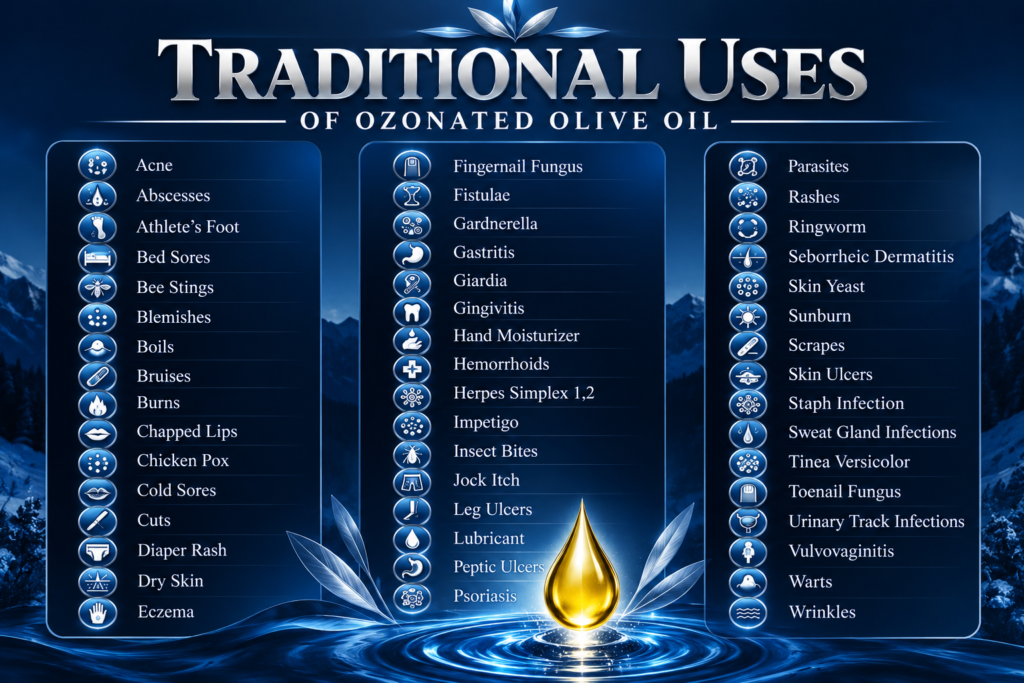
Ozonated Olive Oil Benefits and Traditional Uses
When people search for ozonated olive oil benefits, they may be looking for everyday cosmetic uses or information about scientific research. Those are different questions. As a skin-care product, an oil-based preparation may help condition dry-feeling skin and soften rough areas. Claims about treating infections, healing wounds or managing diseases require stronger evidence.
Laboratory studies have explored antimicrobial activity, and some clinical research has examined topical applications. Results from laboratory experiments do not necessarily predict what happens on human skin, and evidence is not sufficient to treat ozonated olive oil as a replacement for established medical care.
Skin Care & Moisturizing
- Conditioning dry-feeling skin
- Softening rough elbows and knees
- Adding an oil-based step to a cosmetic routine
- Helping hands and cuticles feel less dry
Antimicrobial Research
- Explored in laboratory studies
- Results depend on the formulation and test conditions
- Laboratory activity does not prove treatment effectiveness in people
Facial & Cosmetic Care
- Conditioning dry facial areas, if tolerated
- Reducing the appearance of dryness through moisturizing
- Applying sparingly to avoid an overly greasy feel
Skin & Wound Research
- Studied in some wound-care settings
- Evidence varies by study and preparation
- Open wounds and infections require appropriate professional care
For a closer look at published research, visit our O3 Science page. Research summaries should be read alongside each study’s limitations.
Traditional Skin-Care Applications
People use ozonated olive oil in different personal-care routines. The following are examples of cosmetic applications, not treatments for medical conditions.
Dry skin and rough patches
A small amount may be spread over clean, intact skin on areas such as elbows, knees or heels. Because some formulations are thick, start with less than you think you need and add more only if comfortable.
Hands and cuticles
For dry-feeling hands, apply a thin layer after washing and drying. Avoid broken skin and stop if stinging, redness or itching develops.
Face and everyday grooming
Some people include oil-based products in a facial routine, especially on dry areas. Patch-test first, avoid the eye area and consider whether a rich, strongly scented product suits your skin. After shaving, wait until skin is intact and no longer irritated.
Lips, feet and seasonal dryness
For cosmetic care, use only products whose labeling supports the intended application. Avoid accidental ingestion, mucous membranes, cracked or bleeding skin, and any area showing signs of infection.
How to Use Ozonated Olive Oil
For routine external cosmetic use, begin with clean, dry, intact skin. Apply a small amount to a limited area and spread gently. Ozonated olive oil can feel thicker than ordinary olive oil, so a thin layer is often enough.
Before your first application
- Read the instructions supplied with your specific product.
- Patch-test a small area first and watch for irritation before wider use.
- Keep the preparation away from eyes and mucous membranes.
- Stop use if burning, rash, swelling or persistent irritation develops.
Do not apply to open wounds, burns, infected skin or persistent skin conditions without advice from a qualified health professional. Do not ingest it or use it for oil pulling or internal conditions unless specifically advised by an appropriately qualified clinician.
Ozonated Olive Oil Storage & Shelf Life
Storage conditions matter because oils and their reaction products can change with time, heat, light and exposure to air. Follow the manufacturer’s instructions for your particular preparation.
- Keep the lid tightly closed when not in use.
- Protect the jar from direct sunlight and excessive heat.
- Refrigerate when recommended on the product label; EarthOnated emphasizes refrigerated handling.
- Use clean hands or a clean applicator to avoid contaminating the contents.
- Check the product’s stated expiry or best-before date.
How long does ozonated olive oil last? There is no universal shelf life. It depends on the formula, processing, packaging and storage, and should be supported by manufacturer-specific stability information rather than assumed from appearance or odor.
Are There Any Ozonated Olive Oil Side Effects?
Possible unwanted reactions include redness, itching, stinging, irritation or contact sensitivity. Skin that is already inflamed or damaged may be more vulnerable to irritation.
Patch-test first, avoid the eyes, and discontinue use if a reaction occurs. Seek medical advice for severe or persistent symptoms. Natural ingredients are not automatically suitable for every skin type, and a cosmetic product is not a substitute for assessment of a new or worsening skin problem.
Ozonated Olive Oil and Pets
Some alternative-care discussions mention ozonated olive oil for animals, but human skin-care instructions should not automatically be applied to pets. Animals may lick products from their skin, creating an ingestion concern.
There is insufficient reliable evidence that licking or ingesting ozonated olive oil eliminates intestinal worms or parasite eggs. Suspected parasites, wounds or skin infections should be assessed by a veterinarian. Do not substitute ozonated olive oil for veterinary deworming medication or prescribed treatment.
Frequently Asked Questions About Ozonated Olive Oil
Is ozonated olive oil the same as regular olive oil?
No. Regular olive oil has not undergone the controlled ozone reaction that creates oxygen-containing compounds in ozonated olive oil.
Why is some ozonated olive oil thick?
Ozonation can change the oil’s physical properties. Texture depends on processing conditions and composition; thickness alone does not prove effectiveness.
Does ozonated olive oil have a strong smell?
Some preparations have a distinctive odor. The scent varies by formulation and is not a reliable standalone measure of quality or strength.
Can ozonated olive oil cure skin infections?
It should not be presented as a proven cure. Laboratory research is not the same as reliable clinical evidence, and suspected infections need appropriate medical evaluation.
Can I use ozonated olive oil every day?
Frequency depends on the product instructions and individual skin tolerance. For cosmetic use on intact skin, start conservatively and discontinue if irritation develops.
Final Thoughts
Ozonated olive oil is a distinctive
preparation produced through the
controlled reaction of ozone with olive oil.
Its consistency and composition have
made it an interesting subject for
cosmetic applications and scientific study.
For everyday topical care, quality
ingredients, careful production,
appropriate packaging, and proper
storage all deserve consideration.
Discover EarthOnated
Explore our selection of ozonated olive
oil and other products in the
EarthOnated Online Store.