
Colloidal Silver (Nano Silver): Uses, Science & Safety
Silver has fascinated people for thousands of years.
From its historical use in preserving materials to
modern scientific investigations of microscopic
silver particles, this remarkable metal continues
to attract attention around the world.
Discover its history, unique properties, and
what scientific research tells us today.
What Is Colloidal Silver?
Colloidal silver generally refers to a liquid
containing extremely small particles of silver
suspended throughout it.
Unlike an ordinary piece of silver metal,
these particles can be so small that they
cannot be seen individually with the
naked eye.
The word “colloidal” describes a mixture
in which tiny particles remain dispersed
within another substance, usually a liquid.
Some silver solutions contain mostly
microscopic particles, while others
contain dissolved silver ions or a
combination of both.
This distinction matters because
different forms of silver can behave
differently in laboratory experiments
and practical applications.
What Is Nano Silver?
Nano silver is a term commonly used for
extremely small particles of metallic
silver measured in nanometers.
A nanometer is one-billionth of a meter.
To put that into perspective, a human
hair is tens of thousands of nanometers
wide.
Scientists study silver at this tiny
scale because reducing particle size
changes the amount of surface area
available to interact with the
surrounding environment.
Microscopic Particles
Silver nanoparticles are too small
to see individually without
specialized scientific equipment.
Large Surface Area
Smaller particles can expose more
surface area relative to their
volume, influencing how they
interact with other materials.
Silver Ions
Some silver formulations contain
dissolved silver ions, which
have different chemical properties
from metallic particles.
Different Formulations
Products described as colloidal
silver or nano silver may differ
in particle size, concentration,
purity, and composition.
A Brief History of Silver
Silver has been valued by civilizations
for thousands of years, both as a
precious metal and for its practical
properties.
Historically, silver vessels were
sometimes used for storing liquids.
Long before modern microbiology,
people observed that certain materials
could influence how substances
were preserved.
During the nineteenth and early
twentieth centuries, silver-containing
preparations were investigated and
used in various medical settings.
With the development of modern
antibiotics and improved medical
treatments, many historical uses
of colloidal silver declined.
Today, silver remains important in
specialized medical materials,
laboratory research, electronics,
filtration technology, and
industrial manufacturing.
The fact that silver was used
historically does not establish
that a modern colloidal silver
solution is safe or effective
for treating illness.
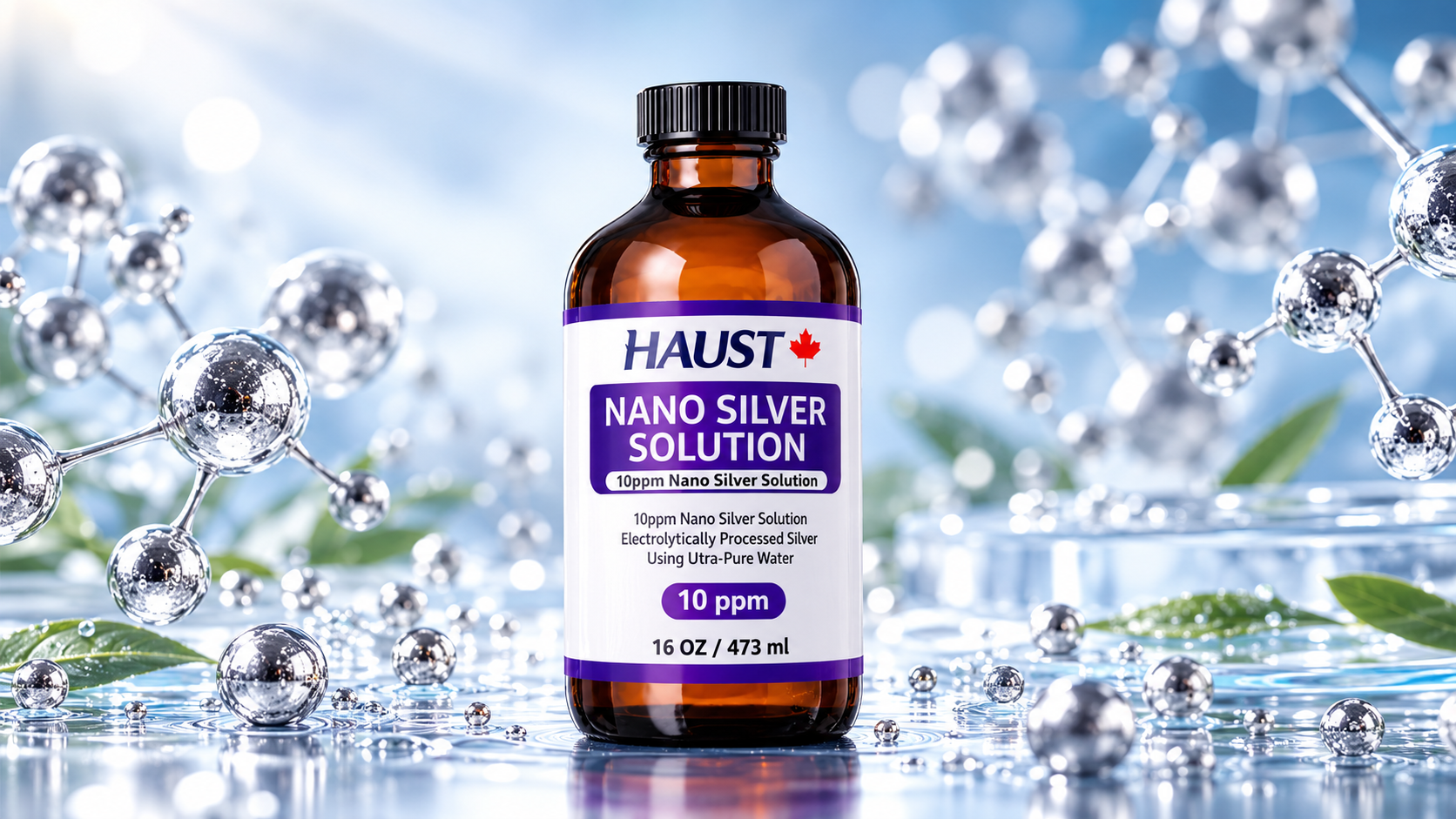
Understanding 10 Parts Per Million (10 PPM)
EarthOnated Nano Silver Solution
is described as a 10 parts per
million formulation.
Parts per million, abbreviated
PPM, is a measurement used to
describe the concentration of
a substance within a mixture.
In a dilute water-based solution,
10 PPM represents approximately
10 milligrams of silver per liter,
assuming the stated concentration
refers to total silver.
PPM tells us about concentration,
but it does not tell us the size
of the silver particles or how
much of the silver is present
in dissolved ionic form.
Those details require appropriate
laboratory testing.
A concentration of 10 PPM
is not, by itself, proof
of purity, safety, effectiveness,
or suitability for ingestion.
Why Are Scientists Interested in Silver Nanoparticles?
Modern researchers investigate
silver nanoparticles because
of their unusual physical
and chemical properties.
In controlled laboratory
environments, certain silver
particles and silver ions
can interfere with the
functioning of microorganisms.
Scientists have observed effects
involving bacterial cell membranes,
proteins, and other important
cellular processes.
Research also examines how silver
interacts with surfaces, materials,
and microorganisms that form
protective communities known
as biofilms.
These discoveries have encouraged
investigation into specialized
silver-containing coatings,
medical materials, and other
technologies.
However, laboratory activity
against microorganisms is not
the same as proving that a silver
solution can safely treat infections
inside the human body.
What Have Scientific Studies Discovered About Silver?
Published scientific research provides
valuable insight into the properties
of silver. The following summaries
explain several important findings
in simple, everyday language.
How Does Silver Interact With Microorganisms?
Scientists have investigated the
ways silver nanoparticles and
dissolved silver ions interact
with bacteria and other
microorganisms.
Laboratory studies indicate that
silver can affect cell membranes,
interfere with proteins, and
disrupt important cellular
functions under certain conditions.
These findings help researchers
understand why silver is used
in some specialized antimicrobial
materials.
The results depend on factors
such as the type of organism,
silver concentration, particle
characteristics, and experimental
conditions.
of silver nanoparticles and silver ions.
Why Does Particle Size Matter?
Silver nanoparticles are studied
partly because very small particles
have a relatively large surface
area compared with their volume.
This can influence how they interact
with surrounding materials and
how silver ions are released.
Researchers also examine particle
shape, surface coatings, stability,
and the surrounding chemical
environment.
Consequently, two products with
the same PPM concentration may
have different physical and
chemical characteristics.
surface chemistry, and stability.
What Have Researchers Learned About Biofilms?
Some microorganisms can attach
themselves to surfaces and form
organized communities called
biofilms.
These communities are surrounded
by protective materials that
can make microorganisms more
difficult to remove.
Scientists investigate whether
silver-containing materials can
influence the formation or
development of certain biofilms.
Findings from these experiments
may help guide the development
of specialized coatings and
surface technologies.
materials and microbial biofilms.
How Is Silver Used in Modern Medical Materials?
Certain regulated medical products,
including some wound dressings,
incorporate silver as part of
their design.
Researchers study how these
materials release silver and
how they behave in controlled
clinical applications.
The performance of a specialized
medical dressing cannot be
assumed to apply to a bottled
colloidal silver solution.
Each product requires its own
evidence concerning safety,
effectiveness, and intended use.
dressings and medical materials.
What Are Scientists Investigating About Safety?
Alongside potential technological
applications, scientists investigate
how silver particles and ions
interact with human cells
and biological tissues.
Laboratory research examines
possible effects related to
concentration, particle size,
duration of exposure, and
routes of contact.
Excessive or prolonged silver
exposure can present risks,
including argyria, a potentially
permanent bluish-gray
discoloration of the skin.
These questions are important
because a substance that affects
microorganisms in a laboratory
may also affect other living cells.
toxicology and human exposure.
These summaries describe general
research areas rather than clinical
proof that EarthOnated Nano Silver
Solution prevents, treats, or cures
any disease.
Where Is Silver Used Today?
Silver has applications far beyond
jewelry and decorative objects.
Its electrical, optical, and
chemical properties make it
valuable in many industries.
Electronics
Silver is widely used in
electrical contacts, conductive
components, and specialized
electronic technologies.
Medical Materials
Certain regulated dressings
and medical products contain
silver for specific,
controlled applications.
Surface Coatings
Researchers investigate
silver-containing coatings
for particular industrial
and technical environments.
Laboratory Research
Silver nanoparticles are
studied in materials science,
chemistry, microbiology,
and nanotechnology.
Important Considerations About Colloidal Silver
Interest in silver’s unusual
properties should be balanced
with a clear understanding
of the available evidence.
Scientific research involving
silver nanoparticles, silver
ions, or specialized medical
materials does not automatically
establish the safety or benefits
of consumer colloidal silver
preparations.
Health authorities caution
against consuming colloidal
silver because it has not been
established as safe or effective
for treating disease and can
cause serious adverse effects.
Silver can accumulate in the
body, and prolonged exposure
may cause argyria. Silver
products may also interfere
with the absorption of certain
medications.
Do not ingest colloidal silver
or use it in the eyes, on wounds,
or for medical treatment unless
specifically directed by a
qualified healthcare professional
using an appropriately authorized
product.
Frequently Asked Questions About Nano Silver
Is nano silver the same as colloidal silver?
The terms are often used
interchangeably in product
descriptions, but they are
not necessarily identical.
Nano silver generally refers
to silver particles measured
on the nanometer scale, while
colloidal silver refers more
broadly to a liquid dispersion
containing tiny silver particles.
What does 10 PPM mean?
Ten parts per million describes
the concentration of silver
in a solution. In a dilute
water-based formulation, it
represents approximately
10 milligrams per liter
when measured as total silver.
Does a higher PPM mean better quality?
Not necessarily. Concentration
is only one characteristic.
Particle size, composition,
purity, stability, and
manufacturing controls
also matter.
Can silver nanoparticles be seen?
Individual silver nanoparticles
are generally too small to
be seen with the naked eye.
Specialized laboratory
equipment is required to
examine them directly.
Why do scientists study silver?
Researchers are interested
in silver’s physical,
chemical, electrical,
and antimicrobial properties.
These characteristics are
relevant to materials science,
electronics, specialized
coatings, and certain
medical technologies.
Is colloidal silver approved as a treatment for illness?
Consumer colloidal silver
solutions have not been
established as safe or
effective treatments for
diseases. Research involving
specialized silver-containing
medical products does not
establish the effectiveness
of bottled colloidal silver.
Does EarthOnated Nano Silver contain 10 PPM?
EarthOnated Nano Silver
Solution is described as
a 10 PPM formulation.
This concentration does
not independently establish
its particle size, purity,
or suitability for any
particular use.
Discover More About Silver
From ancient craftsmanship
to modern nanotechnology,
silver continues to be
a fascinating subject
of scientific investigation.
Understanding the difference
between silver particles,
dissolved silver ions,
concentration, and
laboratory research helps
consumers evaluate information
more carefully.
EarthOnated believes in
presenting product information
clearly while recognizing
the difference between
scientific investigation
and established medical evidence.
Explore Nano Silver at EarthOnated
Discover EarthOnated Nano Silver
Solution and explore our selection
of carefully presented products
in the EarthOnated online store.